

Abstract
Liquidity and capital are fundamentally distinct financial states that markets, regulators, and practitioners frequently conflate, often with systemic consequences. Liquidity measures the ease and cost of converting assets into cash over a specific time horizon; capital measures the sufficiency of assets to absorb losses and satisfy long-term obligations. This distinction matters structurally because liquidity crises and solvency crises follow different mechanisms, require different remedies, and can mask or accelerate one another. An institution may be temporarily illiquid yet remain solvent, or possess abundant cash yet face insolvency. The confusion between these states emerges from multiple sources: information asymmetry about asset values, the endogenous interaction between funding conditions and asset prices, and the feedback loops that can cause illiquidity to precipitate insolvency despite a solvent underlying state.
Problem Statement
The 2008 financial crisis reveals the costliness of the liquidity-capital distinction. Lehman Brothers maintained investment-grade ratings from major agencies immediately before bankruptcy, suggesting fundamental solvency in accounting measures, yet the firm collapsed from an inability to access short-term funding markets. Conversely, most financial institutions that received government bailouts repaid those funds with interest, indicating they were illiquid but never fundamentally insolvent. This pattern indicates that markets systematically conflate access to liquidity with capacity to generate cash flows and sustain operations.
The structural confusion manifests in regulatory frameworks, where liquidity requirements (Basel III Liquidity Coverage Ratio) and capital requirements operate as separate, often inadequately coordinated mechanisms. It appears in pricing, where equity traders respond to liquidity conditions as proxies for solvency, driving prices through illiquidity premiums disconnected from fundamental value. It appears in institutional behavior, where short-term creditors withdraw funding based on signals about liquidity access rather than assessments of underlying solvency, creating self-fulfilling runs.
This problem is not merely semantic. The distinction between liquidity and capital determines which interventions stabilize financial systems and which amplify instability. Central bank liquidity provision addresses illiquidity but cannot address insolvency. Margin requirements address capital constraints but create liquidity feedback loops. The failure to maintain this distinction operationally leads to interventions that stabilize one dimension while destabilizing another.
Framework and Method
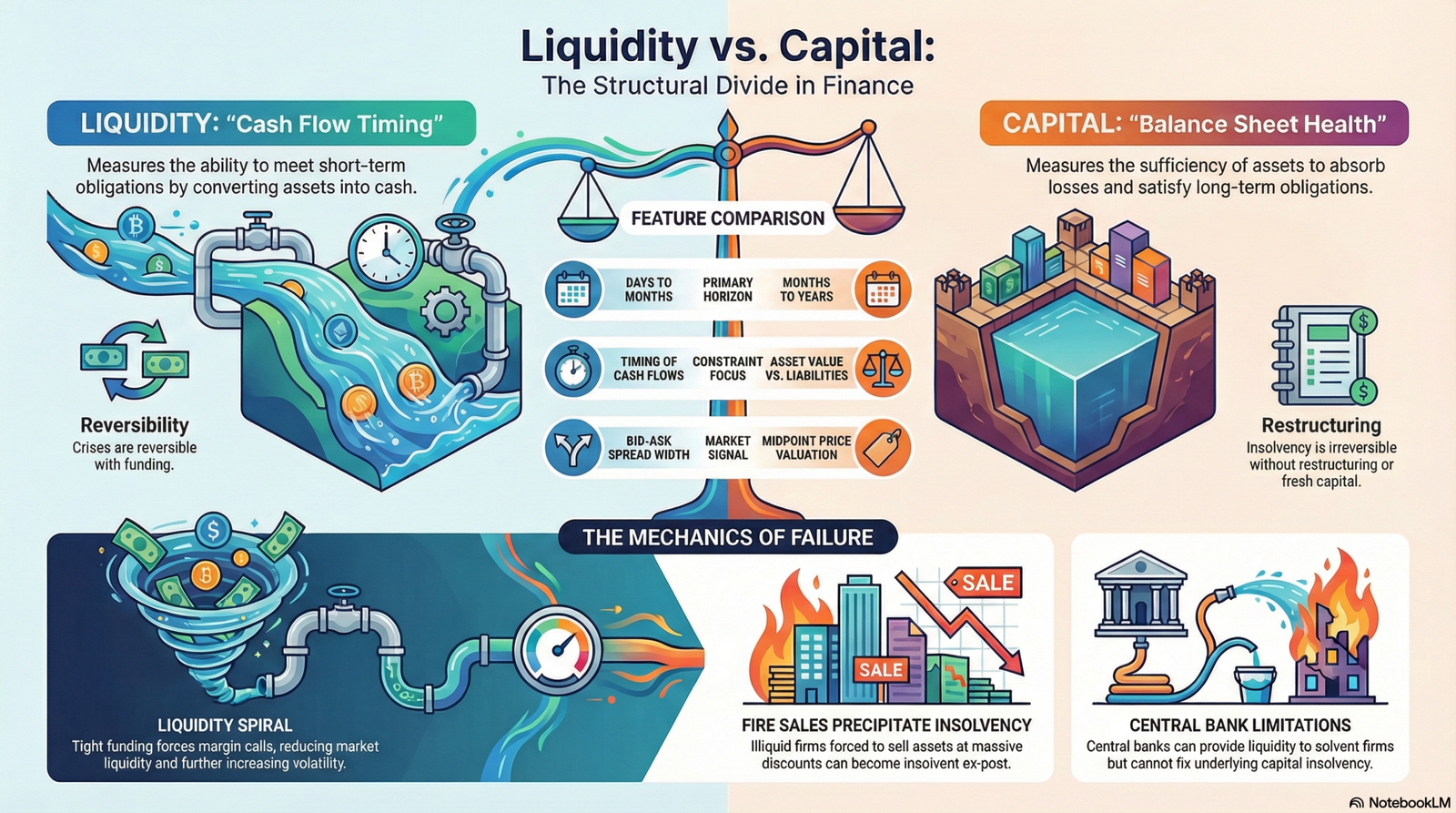
- Time horizons: Liquidity concerns typically involve obligations due within days to months; capital concerns involve obligations over months to years.
- Price determination: Liquidity constraints affect the spread between ask and bid; fundamental insolvency affects the midpoint itself.
- Reversibility: Liquidity crises are typically reversible if access to funding markets is restored; insolvency is irreversible without restructuring or fresh capital injection.
Analysis
Market Liquidity and Funding Liquidity as Distinct Systems
Markets distinguish between two liquidity concepts that interact but remain structurally separate.
Market liquidity refers to the properties of financial assets themselves: the ease with which they can be bought or sold in quantity at prices close to recent transaction prices. Empirically, this manifests as bid-ask spreads typically measured in basis points, order book depth measured in shares available for trade at each price level, and price impact measured as the price concession required to execute a large order.
Funding liquidity refers to the availability of funds to traders, dealers, and investors to finance positions and meet obligations. It is measured by the cost and availability of secured and unsecured credit, collateral requirements (margins), haircuts on repo transactions, and the ability to roll over maturing debt. Funding liquidity is constrained when credit conditions tighten, when collateral quality deteriorates, when risk premiums widen, or when short-term funding markets freeze.
The key structural insight is that these two systems reinforce one another under both favorable and adverse conditions, creating feedback loops that amplify shocks. When dealer capital is abundant and margin requirements are low, dealers can fund large positions and provide substantial market liquidity; abundant market liquidity, in turn, reduces price volatility and collateral risk, which lowers margin requirements and attracts more dealer capital. The reverse occurs under stress: reduced dealer capital necessitates higher margins; higher margins reduce dealers’ ability to provide liquidity; reduced liquidity widens spreads and increases volatility; increased volatility justifies higher margins; and the cycle reinforces. Brunnermeier and Pedersen term this dynamic a “liquidity spiral.”
Critically, this feedback loop operates independently of solvency. A solvent dealer with temporarily reduced capital, or a solvent market with temporarily tight funding conditions, can nonetheless experience severe illiquidity. The market price can deviate sharply from fundamental value not because the asset is worthless, but because the financial intermediaries willing to bridge the gap between buyers and sellers have constrained capital and face elevated margins.
Illiquidity as Distinct from Insolvency
The distinction between illiquidity and insolvency may be illustrated through a decomposition of financial distress.
An institution is illiquid if it cannot convert assets into cash quickly or if it would incur large costs (haircuts, fire-sale discounts) to do so, despite possessing assets that, if held to maturity or liquidated in orderly fashion, would exceed its liabilities. Illiquidity is a cash flow timing problem. It manifests when short-term obligations exceed readily available cash and liquid assets, but long-term asset values exceed total liabilities.
An institution is insolvent if its total liabilities exceed its total assets at fundamental value, or if expected future cash flows cannot service total debt obligations. Insolvency is a balance sheet structure problem. It is irreversible without debt restructuring or fresh capital.
The critical observation is that these states are not synonymous. A solvent firm can become temporarily illiquid if its maturity structure misaligns—if, for example, it finances long-term assets with short-term debt and those debt markets freeze. Conversely, a firm with substantial liquid assets may nonetheless be insolvent if the present value of future operations cannot support the total debt outstanding.
Lehman Brothers illustrates this distinction empirically. The bank maintained investment-grade ratings immediately before collapse, suggesting market expectations that assets exceeded liabilities. Yet Lehman faced a rollover problem: its short-term funding markets froze because market participants feared the bank could not roll over maturing debt, not necessarily because the underlying asset base was worthless. Once creditors ceased renewing repo agreements, the bank lacked the immediate cash to meet obligations and was forced to sell assets, which further depressed prices and eroded asset values. The distinction between an initially solvent institution rendered illiquid by funding market closure and one that was always insolvent but had hidden leverage (through accounting tricks like Repo 105) remains empirically contestable, yet the mechanism of failure was distinctly one of liquidity access.
In contrast, a solvent institution with abundant liquid assets would have survived the same repo market shock; it could have paid off maturing obligations with cash and waited for markets to stabilize.
Price Discovery and Valuation Under Liquidity Constraints
A fundamental source of confusion arises because illiquidity distorts price discovery, creating the appearance of insolvency when the problem is transient access.
In theory, the equilibrium price of an asset reflects supply and demand, weighted by participants’ information and their cost of capital. When market participants become risk-averse or are constrained by capital ratios, the cost of capital rises, the number of willing buyers declines, and the equilibrium price falls. This price decline is theoretically defensible: it reflects the scarcity of willing intermediary capital.
However, under conditions of acute illiquidity with information asymmetry, prices can fall below even this liquidity-adjusted fundamental value. The mechanism is adverse selection. If a buyer observes a seller offering an asset at a depressed price, the buyer cannot distinguish whether the seller is forced to liquidate (liquidity-driven) or is privy to adverse information about asset quality (information-driven). This uncertainty generates a “lemons problem”: buyers assume the worst and demand additional discounts. The more pronounced the illiquidity, the more buyers suspect adverse selection, and the wider the discount below fundamental value.
This dynamic creates a vicious cycle during crises. Illiquidity triggers adverse selection concerns; adverse selection concerns widen spreads further; wider spreads reduce market depth; reduced depth concentrates the positions of remaining market makers, who require higher capital to manage concentration risk; constrained capital reduces liquidity provision; reduced liquidity creates further adverse selection concerns.
Empirically, this manifests as asset prices that fall below the present value of expected future cash flows even when solvency is not questioned by all market participants. The equity of a solvent firm may collapse in price if the firm’s debt becomes illiquid and creditors demand immediate repayment. The price of collateral may halve if it becomes associated with distressed sellers, even if the collateral’s intrinsic cash flows are unchanged. These price movements signal illiquidity, not necessarily insolvency.
The Solvency-Liquidity Nexus Under Maturity Mismatch
The structural relationship between solvency and liquidity deepens when institutions finance long-term assets with short-term liabilities, creating maturity mismatch and rollover risk.
A bank that lends long (mortgages, infrastructure loans with 10+ year maturities) but borrows short (deposits callable on demand, commercial paper rolling every 90 days) faces continuous refinancing risk. Each rollover date presents an opportunity for creditors to refuse renewal. This risk is purely structural and arises even for solvent institutions: if the bank’s loans will eventually generate sufficient cash to repay all debt, the bank is solvent, yet it remains vulnerable to a run if creditors coordinate on non-renewal.
Game-theoretic analysis reveals the mechanism: a short-term creditor faces strategic uncertainty about whether other creditors will roll over. If they expect others to withdraw, rational creditors should withdraw first, converting liquidity risk into solvency risk through forced asset sales. The bank that is solvent ex-ante becomes insolvent ex-post because it is forced to liquidate illiquid assets at fire-sale prices, destroying value.
The solvency-liquidity nexus becomes especially acute when institutions face both capital constraints and funding pressures simultaneously. Pierret (2015) documents empirically that banks with higher stress-test capital shortfalls (SRISK) subsequently face reduced access to short-term funding: a one-unit shock to the capital shortfall ratio reduces short-term funding by approximately 1.1 percent. Conversely, banks with elevated short-term debt obligations face higher capital shortfall risk in crises: each 1 percent increase in short-term debt increases the expected capital shortfall by 0.9 percent. This asymmetric interaction reveals that solvency and liquidity are not independent dimensions; solvency concerns reduce liquidity access, and excessive liquidity mismatch amplifies solvency risk.
Collateral, Margins, and Procyclical Amplification
The interaction between solvency and liquidity becomes most acute through collateral mechanisms in secured funding markets.
In repo markets and margined derivatives markets, counterparty risk is mitigated by collateral, and the amount of collateral required is specified through margin and haircut schedules. As an institution’s solvency position deteriorates (asset prices fall, credit spreads widen), margin requirements typically increase, forcing the institution to post additional collateral.
This mechanism is inherently procyclical. When markets fall, both asset values decline (solvency deterioration) and collateral demand increases (liquidity drain). An institution must simultaneously fund additional margin calls while its available liquid assets are declining in market value. If collateral is not available or if liquid assets are tied up in margin, the institution faces a forced deleveraging: it must sell assets to raise cash, which further depresses prices, justifies higher margins, and necessitates further asset sales. This “margin spiral” can render a temporarily undercapitalized but fundamentally solvent institution insolvent through forced liquidation of long-term assets at distressed prices.
The procyclicality of margins is not accidental but reflects the information problem faced by lenders. When volatility increases, lenders cannot distinguish increases in fundamental risk from increases in liquidity-driven risk; therefore they increase margins to control value-at-risk (VaR). This rational response by individual lenders creates a collectively destabilizing outcome.
Empirically, the 2022 liability-driven investment (LDI) crisis in UK gilt markets exhibited this mechanism acutely. Life insurers and pension funds funded long-duration interest-rate hedges with short-term collateral. When gilt prices fell (a solvency shock to those holding long positions), margin calls (liquidity demands) spiked. As insurers sold gilts to meet margins, gilt prices fell further, justifying higher margins, creating a feedback loop that threatened the solvency of institutions that were not insolvent by economic fundamentals.
Capital as a Constraint Distinct from Liquidity Access
Yet capital and liquidity remain analytically separable because capital shortages operate through different transmission mechanisms than liquidity shortages, even though the two interact.
A capital-constrained institution is one whose equity capital is insufficient to absorb expected or potential losses from its asset holdings, given leverage ratios. This is measured through regulatory capital adequacy ratios or, under stress, through measures like SRISK that estimate the capital the institution would need to raise to restore a given capital ratio if a market shock occurred.
Capital constraints operate primarily through the debt-equity margin: institutions with insufficient capital cannot borrow at competitive rates because lenders perceive elevated default risk, and equity investors demand high returns to compensate for loss probability. Capital constraints thus raise the cost of funding and, in severe cases, cut off access to equity markets entirely. However, capital constraints need not immediately create illiquidity: a well-capitalized institution with liquid assets can remain solvent and liquid; an institution that loses capital but retains access to term funding markets can continue operations.
Conversely, liquidity constraints operate through the maturity structure of obligations and the functioning of short-term funding markets. An institution can face acute illiquidity while maintaining substantial capital reserves if its short-term obligations exceed its liquid assets and refinancing markets freeze. The distinction is critical: a central bank can address liquidity by providing term funding and accepting a broad collateral base; a central bank cannot address capital insolvency through liquidity provision alone.
Empirically, the distinction appears in cross-sectional variation: large, well-capitalized financial institutions (major banks, central clearing counterparties) can occasionally face acute liquidity stress without insolvency concerns, while smaller, undercapitalized institutions can face illiquidity combined with solvency risk even during periods when overall market liquidity is adequate. The 2020 “dash for cash” illustrated this: even highly-rated money market funds faced liquidity pressures and margin calls when short-term funding markets froze, despite being backed by short-term, investment-grade assets.
Fire Sales and the Mechanics of Illiquidity-Driven Insolvency
The most important mechanism by which illiquidity precipitates insolvency is forced asset sales at fire-sale discounts.
Shleifer and Vishny (1992) provide the foundational insight: asset liquidity disappears when the natural buyers of an asset—typically firms in the same industry who understand the asset and can use it productively—are themselves financially constrained and cannot provide competitive bids. In their absence, liquidity comes from financially distant buyers (generalist distressed debt funds, foreign investors with no operational knowledge of the asset class) who demand substantial discounts, both for lack of operational understanding and for the risk of holding unwanted inventory.
When a firm is forced to liquidate assets due to binding liquidity constraints (funding market closure, margin calls), it cannot wait for high-valuation buyers to become available; it must sell to whoever will purchase immediately, typically at a significant discount to the present value of expected cash flows. This discount—the fire-sale cost—can range from 10 to 50 percent of fundamental value depending on asset specificity and the distribution of buyer wealth.
For an institution that is solvent under orderly liquidation but is forced to immediate distressed liquidation, fire sales can render it insolvent: the market value of assets, net of fire-sale discounts, falls below liabilities. The firm transitions from solvent-illiquid to insolvent through the mechanics of forced asset sales, not through deterioration in the underlying economic fundamentals.
This mechanism is especially consequential in markets where natural buyers are concentrated and themselves become undercapitalized during systemic stress. In structured credit markets during 2008, for example, investment banks typically provided liquidity and maintained inventory in mortgage-backed securities. When these banks themselves faced capital constraints and margin calls, they ceased providing liquidity, causing bid-ask spreads to widen by an order of magnitude and forced sellers (mortgage servicers, collateralized debt obligation managers) to liquidate at severe discounts. The solvency crisis in mortgages reflected not just the underlying default rates on mortgages (which would have caused losses) but also the liquidity collapse that forced assets to be sold at prices unrelated to expected cash flows.
Information Asymmetry and Market Breakdown
The distinction between liquidity and solvency obscures when information asymmetry becomes severe. In markets with heterogeneous information about asset quality, illiquidity-induced pricing can trigger a complete breakdown of trade if the fraction of distressed sellers becomes too large.
The mechanism is as follows: in normal conditions, informed and uninformed traders coexist. Informed traders buy from liquidity-pressured sellers, profiting from the gap between fire-sale prices and fundamental value. This activity narrows spreads and maintains market function. However, when the proportion of liquidity-pressured sellers becomes large (due to systemic margin calls, funding market freezes affecting many institutions), buyers cannot distinguish liquidity-driven sales from information-driven sales (sales based on private negative information). The adverse selection discount widens as buyers assume a higher probability that offered assets are low-quality.
As spreads widen, fewer uninformed traders are willing to sell, reducing the supply of assets from those without liquidity pressures. The remaining sellers are increasingly concentrated among the distressed. Buyers infer still higher adverse selection risk. In extreme cases, the bid price falls below the ask price of even the most desperate sellers: markets freeze. This can occur even if no fundamental deterioration in asset values has taken place; the information asymmetry becomes too severe for trade to clear.
The market freeze is an equilibrium with multiple possible outcome: one equilibrium with active trade and moderate spreads (if buyers believe most sellers are liquidity-driven), and another with inactive trade and massive spreads or no trade at all (if buyers believe sellers are information-driven). Small changes in beliefs can trigger transition between equilibria.
This mechanism clarifies why illiquidity appears to signal insolvency when, in fact, it only signals information asymmetry about who is solvent and who is not. In the corporate bond markets during spring 2020, investment-grade bonds from solvent firms (with no deterioration in fundamentals) experienced liquidity collapses because buyers feared the bonds were being sold by informed traders who possessed negative information. The subsequent Fed intervention to purchase corporate bonds and reduce information asymmetry restored liquidity without any change in fundamentals, yet prices recovered sharply.
Implications
Regulatory and Monetary Policy Coordination
The distinction between liquidity and capital implies that regulatory frameworks require structural coordination that does not currently exist. Basel III mandates both capital ratios (Tier 1 at 7% of risk-weighted assets) and liquidity ratios (Liquidity Coverage Ratio of 100% over 30 days). Yet capital requirements and liquidity requirements often pull in opposite directions.
Capital requirements encourage institutions to hold capital-light assets (short-term government securities) because they carry low risk weights. Liquidity requirements encourage holding the same assets to meet LCR standards. Yet both create concentration risk: if all banks hold the same highly-liquid, capital-light assets, then a shock to those asset classes creates simultaneous capital and liquidity stress. Conversely, if banks diversify into illiquid long-term assets to escape capital charges, they become vulnerable to illiquidity spirals even when adequately capitalized.
The procyclicality of collateral haircuts and margins creates similar coordination failure. Individual institutions rationally increase margins during volatility to control value-at-risk; collectively, this amplifies liquidity demand during stress precisely when liquidity is scarcest. Regulatory frameworks have begun to address procyclicality through countercyclical capital buffers and stress-test-based capital surcharges, but no equivalent mechanism currently constrains procyclical margin setting in repo and derivatives markets
Central Bank Liquidity Provision and Its Limits
The distinction between liquidity and capital determines the scope and limitations of central bank intervention. Central banks control the supply of base money and can always exchange base money for a broad range of assets at predetermined rates. In principle, this capability should eliminate liquidity-driven insolvency: any solvent institution can obtain funding by posting collateral to the central bank.
However, central bank liquidity provision does not address insolvency. If an institution is insolvent—if its expected lifetime cash flows cannot service its debt obligations—then liquidity from the central bank merely defers, rather than resolves, the problem. The institution will eventually default when the liquidity runs out or when accounting losses exhaust remaining capital. This distinction was operative in 2008: the Federal Reserve’s liquidity provision (discount window, Term Auction Facility, Primary Dealer Credit Facility) forestalled immediate failures but could not prevent Lehman Brothers’ eventual collapse, which was driven by solvency not liquidity (even if initially masked by funding market dysfunction).
The coordination problem emerges because central bank liquidity provision can paradoxically worsen outcomes if applied to insolvent institutions. By providing funding to an insolvent bank, the central bank delays its resolution and allows it to continue taking risks, which can amplify eventual losses. Alternatively, by distinguishing solvent-but-illiquid institutions from insolvent ones and providing liquidity to only the former, the central bank must make judgments about solvency—an information problem that requires supervisory authority, stress-testing capacity, and willingness to take losses if solvency assessments prove wrong.
Asset Pricing and the Externalities of Illiquidity
Illiquidity creates negative externalities by distorting asset prices in ways that affect the solvency assessments of other institutions. When one asset class becomes illiquid and prices collapse, institutions holding related assets (through correlation in risk factors or because they face margin calls triggered by related assets’ price declines) experience mark-to-market losses even though the underlying fundamentals of their assets are unchanged.
This externality operates through multiple channels. First, mark-to-market accounting rules require institutions to value assets at market prices, not fundamental values. When liquidity collapses, market prices diverge sharply from fundamentals, forcing institutions to recognize paper losses. These losses reduce reported capital, which triggers additional capital requirements or covenant violations, forcing asset sales and amplifying the illiquidity.
Second, portfolio risk models (VaR, stress-testing) often correlate capital requirements with asset volatility or with realized losses in related assets. When illiquidity in one asset class increases volatility or realized losses in that asset class, capital requirements rise for all institutions holding related assets, creating a systemic margin call.
Third, credit rating agencies downgrade institutions whose asset holdings decline in value due to illiquidity-driven price collapses, further restricting their access to short-term funding markets and amplifying illiquidity.
These cascading effects imply that illiquidity in one market segment can render solvent institutions in other segments insolvent through mark-to-market losses, even though the underlying solvency of the distressed segment remains uncertain. The distinction between illiquidity and insolvency becomes purely semantic in the face of accounting rules and covenant structures that equate market prices with fundamental values.
Intervention Design and Targeting
The distinction between liquidity and capital shapes the design of stabilization interventions. A liquidity-targeted intervention should aim to increase the supply of funding to solvent institutions and to restore price discovery in distressed asset classes. This can be accomplished through central bank lending facilities, open-market operations to increase collateral availability, or acceptance of a broader range of collateral in repo and secured lending.
A capital-targeted intervention should aim to recapitalize insolvent or nearly-insolvent institutions through equity injection, debt restructuring, or loan loss provisions. This cannot be accomplished through liquidity provision alone and requires government fiscal involvement or private equity sponsorship.
The most consequential error in intervention design occurs when liquidity interventions are applied to insolvent institutions (delaying resolution) or when capital interventions are applied to liquidity-constrained but solvent institutions (creating unnecessary fiscal costs and moral hazard). The information asymmetry about which institutions are solvent and which are insolvent, coupled with the procyclical feedback loops between illiquidity and insolvency, creates a persistent design problem that no regulatory framework has fully resolved.
Limitations
The analysis presented here relies on equilibrium and partial-equilibrium models that assume rational agent behavior, stable preference structures, and exogenous shocks. In practice, agent behavior during financial crises exhibits herding, overreaction, and changes in risk tolerance that invalidate these assumptions. Liquidity spirals and fire sales are observed empirically, but the relative importance of rational capital constraints versus behavioral factors in driving them remains contested in the literature.
The distinction between illiquidity and insolvency assumes that fundamental asset values are well-defined and that market prices represent valuation error rather than information discovery. In practice, during periods of acute uncertainty (where future cash flows are genuinely unknowable), the concept of fundamental value becomes inoperant and the distinction collapses.
Data limitations prevent precise measurement of the contribution of illiquidity versus insolvency risk to observed institutional failures. Most post-crisis analyses apply historical data and counterfactual reasoning, which introduce specification ambiguity.
Note: Confidence in the liquidity-capital distinction as an explanatory framework remains conditional on the assumption that participants can distinguish market prices from fundamental values and that central banks can identify solvent institutions amid information asymmetry.
Reference
Below is a compact list of the main sources used, grouped by theme.
Core conceptual distinctions: liquidity, solvency, capital
- Board of Governors of the Federal Reserve System, “What is the difference between a bank’s liquidity and its capital?” (FAQ).[1]
- Bank of England, “Bank capital and liquidity.” Quarterly Bulletin, 2013 Q3.[2]
- Testbook, “Difference Between Liquidity and Solvency.”[3]
- Pivot Capital, “Solvency vs. Liquidity: Understanding the Difference.”[4]
Market liquidity, funding liquidity, liquidity spirals
- Brunnermeier, M. K., and L. H. Pedersen, “Market Liquidity and Funding Liquidity.” NBER Working Paper 12939, 2007; Review of Financial Studies, 22(6), 2009.[5][6][7][8][9][10][11]
- BIS, “Market Microstructure and Market Liquidity.” CGFS Papers, 1999.[12]
- BIS, “Overview: market structure issues in market liquidity.” BIS Papers.[13]
- BIS, “Measuring liquidity under stress.” BIS Papers.[14]
- Liquidity spirals notes and working papers (various).[15][16][17][18]
Fire sales, price dislocations, crisis dynamics
- Shleifer, A., and R. Vishny, “Fire Sales in Finance and Macroeconomics.” NBER Working Paper 16642, 2010; Journal of Economic Perspectives, 25(1), 2011.[19][20][21][22]
- HBS research, “Asset fire sales (and purchases) in equity markets.”[23]
- European Systemic Risk Board, “Fire-sales in frozen markets.” ESRB Working Paper.[24]
- BIS, “Fire sales of safe assets.” BIS Working Paper.[25]
Solvency–liquidity nexus, SRISK, systemic risk
- Acharya, V., Engle, R., et al., “Systemic risk and the solvency-liquidity nexus of banks.” International Journal of Central Banking.[26][27]
- Bank of England, “Capital and liquidity at risk with solvency-liquidity interactions.” Working Paper.[28]
- IMF, Chapter 27, “Measuring Systemic Risk-Adjusted Liquidity.”[29]
- ESRB, “Systemic liquidity risk: a monitoring framework.”[30]
Capital structure, liquidity and cost of capital
- Lipson, M. L., and S. Mortal, “Liquidity and capital structure.” Journal articles via ScienceDirect.[31]
- Various work on systematic liquidity risk in housing and other markets.[32][33][34]
Regulatory frameworks: Basel III, LCR, capital ratios
- Basel Committee on Banking Supervision, “Basel III: The Liquidity Coverage Ratio and liquidity risk monitoring tools.” BCBS 238, January 2013.[35][36]
- Basel Committee, “Basel III Capital Regulations.”[37][38]
- IMF, “Basel Capital and Liquidity Standards for Deposit Takers.”[38]
- AnalystPrep, “Financial Regulations of Financial Institutions.”[39]
- Wikipedia, “Basel III” (for high-level LCR summary only).[40]
2008 crisis, Lehman, liquidity vs insolvency
- Economics Help, “Difference between Liquidity Crisis and Solvency Crisis.”[41]
- Economics Observatory, “Why did Lehman Brothers fail?”[42]
- Various academic and institutional post-mortems on Lehman Brothers’ bankruptcy.[43][44][45]
- FSB, “Risk Management Lessons from the Global Banking Crisis of 2008.”[46]
- RBA and other central bank speeches on liquidity, crises, and lender-of-last-resort.[47]
Information asymmetry, adverse selection, market breakdown
- Kirabaeva, K., “Adverse Selection, Liquidity, and Market Breakdown.” Bank of Canada Working Paper.[48]
- Kirabaeva, K., and related work, “The Role of Adverse Selection and Liquidity in Financial Markets.”[49]
- Bertsch, C., “A Model of Liquidity Provision with Adverse Selection.”[50]
- Learning about adverse selection in markets (various).[51]
Collateral, margins, repo, and haircuts
- Glasserman, P., “Counterparty Risk: Collateral, Volatility and Procyclicality.” OFR/academic presentations.[52]
- New York Fed / academic papers, “Repo Markets, Counterparty Risk, and the 2007/2008 Crisis.”[53][54]
- ICMA, “Haircuts and initial margins in the repo market.”[55]
- BIS, “Unpacking repo haircuts and their implications for leverage.” BIS Bulletin.[56][57]
- IMF, “The Economics of Collateral Chains.”[58]
- PwC, “Collateral Management Transformation.”[59]
- DNB, “Collateral optimisation, re-use and transformation.”[60]
Maturity mismatch, rollover risk, ALM
- Research on rollover restrictions and maturity mismatch.[61]
- South Indian Bank, “Asset-Liability Management.”[62]
- GKTODAY, “Asset Liability Management (ALM).”[63]
- Fintelligents, “How does Funding Maturity Gap affect Banks?”[64]
- Szkup et al., “Optimal Debt Maturity Structure, Rollover Risk and Debt Overhang.”[65]
- SSRN, “Bank Rollover Risk and Liquidity Supply Regimes.”[66]
Market microstructure, price discovery, liquidity measures
- BIS, “Market Microstructure and Market Liquidity.”[12][13]
- University lecture notes on market microstructure.[67]
- Fleming, M., “Measuring Treasury Market Liquidity.” Federal Reserve Bank of New York Economic Policy Review.[68]
- ScienceDirect and Investopedia overviews on bid-ask spread and liquidity metrics.[69][70]
- Studies on price discovery and volatility on NSE futures and other markets.[71][72]
Additional supporting and reference materials
- ESRB, “Systemic liquidity risk: a monitoring framework.”[30]
- IMF papers on macro fundamentals, price discovery, and volatility.[71]
- Books/notes on liquidity and leverage (FRM/CFA prep).[73]
- Miscellaneous background sources on liquidity vs solvency definitions and ratios.[74][75][76][3]
Sources
[1] What is the difference between a bank's liquidity and its ... https://www.federalreserve.gov/faqs/cat_21427.htm
[2] Bank capital and liquidity https://www.bankofengland.co.uk/-/media/boe/files/quarterly-bulletin/2013/bank-capital-and-liquidity
[3] Difference Between Liquidity and Solvency https://testbook.com/key-differences/difference-between-liquidity-and-solvency
[4] Solvency vs. Liquidity: Understanding the Difference https://pivotcapitalllc.com/solvency-vs-liquidity-understanding-the-difference/
[5] [PDF] Market Liquidity and Funding Liquidity https://www.nber.org/system/files/working_papers/w12939/w12939.pdf
[6] Market Liquidity and Funding Liquidity - Oxford Academic https://academic.oup.com/rfs/article-abstract/22/6/2201/1592184
[7] revfin-toc.dvi https://www.edegan.com/pdfs/Brunnermeier%20Pedersen%20(2009)%20-%20Market%20Liquidity%20and%20Funding%20Liquidity.pdf
[8] Market Liquidity and Funding Liquidity https://haas.berkeley.edu/wp-content/uploads/Mkt_Fun_Liquidity.pdf
[9] Market Liquidity and Funding Liquidity https://www.nber.org/papers/w12939
[10] Market Liquidity and Funding Liquidity http://home.business.utah.edu/finea/liquidity.pdf
[11] Market Liquidity and Funding Liquidity∗ https://markus.scholar.princeton.edu/document/147
[12] Market Microstructure and Market Liquidity. - May 1999 https://www.bis.org/publ/cgfs11mura_a.pdf
[13] Overview: market structure issues in market liquidity https://www.bis.org/publ/bppdf/bispap02a.pdf
[14] Measuring liquidity under stress https://www.bis.org/publ/bppdf/bispap02i.pdf
[15] Liquidity spiral: What is a liquidity spiral and how to prevent it - FasterCapital https://fastercapital.com/content/Liquidity-spiral--What-is-a-liquidity-spiral-and-how-to-prevent-it.html
[16] Market Liquidity and Funding Liquidity https://www.newyorkfed.org/medialibrary/media/newsevents/events/research/2006/0518-pedersen_brunnermeier_slides.pdf
[17] Liquidity Spirals https://papers.ssrn.com/sol3/papers.cfm?abstract_id=5280553
[18] [PDF] Liquidity Spirals 20230906 https://oms-inet.files.svdcdn.com/production/files/Liquidity-Spirals-20230906.pdf?dm=1694158884
[19] Fire Sales in Finance and Macroeconomics https://www.nber.org/papers/w16642
[20] NBER WORKING PAPER SERIES https://www.nber.org/system/files/working_papers/w16642/w16642.pdf
[21] Fire Sales in Finance and Macroeconomics https://www.aeaweb.org/articles?id=10.1257%2Fjep.25.1.29
[22] Fire Sales in Finance and Macroeconomics https://pubs.aeaweb.org/doi/10.1257/jep.25.1.29
[23] Asset fire sales (and purchases) in equity markets https://www.hbs.edu/ris/download.aspx?name=Asset+Fire+Sales+in+Equity+Markets.pdf
[24] Fire-sales in frozen markets - European Systemic Risk Board https://www.esrb.europa.eu/pub/pdf/wp/esrb.wp100~5e72d55ea0.en.pdf
[25] Fire sales of safe assets https://www.bis.org/publ/work1233.pdf
[26] Systemic risk and the solvency-liquidity nexus of banks https://www.ijcb.org/sites/default/files/journal/v11n3/ijcb-v11n3-systemic-risk-and-solvency-liquidity-nexus-banks.pdf
[27] Systemic risk and the solvency-liquidity nexus of banks https://www.stern.nyu.edu/sites/default/files/assets/documents/con_047616.pdf
[28] capital and liquidity at risk with solvency-liquidity interactions https://www.bankofengland.co.uk/-/media/boe/files/working-paper/2025/measuring-the-stability-of-the-banking-system.pdf
[29] Chapter 27. Measuring Systemic Risk-Adjusted Liquidity in https://www.elibrary.imf.org/display/book/9781484368589/ch027.xml
[30] Systemic liquidity risk: a monitoring framework https://www.esrb.europa.eu/pub/pdf/reports/esrb.report202501_systemicliquidityrisk~90f2044791.en.pdf
[31] Liquidity and capital structure https://www.sciencedirect.com/science/article/abs/pii/S1386418109000287
[32] The pricing of systematic liquidity risks in housing market https://www.sciencedirect.com/science/article/abs/pii/S0197397525002486
[33] Systemic Risk and Market Liquidity* https://www.bde.es/f/webpi/SES/seminars/2014/files/sie1416.pdf
[34] Asset Price Bubbles, Market Liquidity and Systemic Risk https://www.garp.org/hubfs/Whitepapers/a1Z1W0000054wyeUAA.pdf
[35] Basel III: The Liquidity Coverage Ratio and liquidity risk ... https://www.bis.org/publ/bcbs238.pdf
[36] Basel III: The Liquidity Coverage Ratio and liquidity risk ... https://www.bis.org/publ/bcbs238.htm
[37] Basel III Capital Regulations https://www.iibf.org.in/documents/BASEL-III.pdf
[38] 3 Basel Capital and Liquidity Standards for Deposit Takers https://www.elibrary.imf.org/downloadpdf/display/book/9781484396209/ch03.pdf
[39] Financial Regulations of Financial Institutions - CFA, FRM ... https://analystprep.com/study-notes/cfa-level-2/key-aspects-of-financial-regulations-of-financial-institutions/
[40] Basel III - Wikipedia https://en.wikipedia.org/wiki/Basel_III
[41] Difference between Liquidity Crisis and Solvency Crisis https://www.economicshelp.org/blog/5043/economics/difference-between-liquidity-crisis-and-solvency-crisis/
[42] Why did Lehman Brothers fail? https://www.economicsobservatory.com/why-did-lehman-brothers-fail
[43] Lehman Brothers Bankruptcy: Reasons, Effects, and Outcome https://scholarworks.uark.edu/cgi/viewcontent.cgi?article=1090&context=finnuht
[44] Assessment of Lehman Brother's Failure https://www.noveltyjournals.com/upload/paper/Assessment%20of%20Lehman-25112021-2.pdf
[45] what-caused-the-failure-of-lehman-brothers-could-it-have- ... https://www.walshmedicalmedia.com/open-access/what-caused-the-failure-of-lehman-brothers-could-it-have-beenprevented-how-recommendations-for-going-forward-2472-114X-S1-002.pdf
[46] Risk Management Lessons from the Global Banking Crisis ... https://www.fsb.org/uploads/r_0910a.pdf
[47] Discussion on Liquidity, Financial Crises and the Lender ... https://www.rba.gov.au/publications/confs/2008/davis-disc.html
[48] Adverse Selection, Liquidity, and Market Breakdown https://www.banqueducanada.ca/wp-content/uploads/2010/11/Kirabaeva_Koralai.pdf
[49] The Role of Adverse Selection and Liquidity in Financial ... https://cae.economics.cornell.edu/conferences/Koralai.Kirabaeva.pap.pdf
[50] A Model of Liquidity Provision with Adverse Selection https://www.christophbertsch.com/data/liquidity_provision.pdf
[51] LEARNING ABOUT ADVERSE SELECTION IN MARKETS https://papers.ssrn.com/sol3/Delivery.cfm/3286933.pdf?abstractid=3286933
[52] Counterparty Risk: Collateral, Volatility and Procyclicality https://www.financialresearch.gov/conferences/files/paulglasserman_counterparty_risk.pdf
[53] Repo Markets, Counterparty Risk, and the 2007/2008 ... https://papers.ssrn.com/sol3/papers.cfm?abstract_id=1138609
[54] Repo Markets, Counterparty Risk, and the 2007/2008 ... https://www.newyorkfed.org/medialibrary/media/research/conference/2008/mm_policy/Ewerhart_Tapking.pdf
[55] [PDF] Haircuts and initial margins in the repo market https://www.icmagroup.org/assets/documents/Maket-Practice/Regulatory-Policy/Repo-Markets/Haircuts%20and%20initial%20margins%20in%20the%20repo%20market_8%20Feb%202012.pdf
[56] Unpacking repo haircuts and their implications for leveragewww.bis.org › publ › bisbull117 https://www.bis.org/publ/bisbull117.pdf
[57] What drives repo haircuts? Evidence from the UK market https://www.bis.org/publ/work1027.pdf
[58] Financial system - The Economics of Collateral-Chains https://www.imf.org/external/np/res/docs/2012/010112.pdf
[59] Collateral Management Transformation https://www.pwc.com/jp/en/advisory/industry-fs/bcm/assets/pdf/collateral-management-transformation.pdf
[60] Collateral optimisation, re-use and transformation https://www.dnb.nl/media/rzlp1obc/201407_nr-_5_-2014-_collateral_optimisation-_re-use_and_transformation.pdf
[61] Rollover restrictions and the maturity mismatch between ... https://onlinelibrary.wiley.com/doi/abs/10.1002/mde.3594
[62] asset-liability management - South Indian Bank https://www.southindianbank.bank.in/userfiles/file/sef_388.pdf
[63] Asset Liability Management (ALM) https://www.gktoday.in/asset-liability-management-alm/
[64] How does Funding Maturity Gap affect Banks? https://fintelligents.com/how-does-funding-maturity-gap-affects-banks/
[65] Optimal Debt Maturity Structure, Rollover Risk and ... https://www.economics.ubc.ca/wp-content/uploads/sites/38/2014/09/pdf_paper_szkup_debt_overhang.pdf
[66] Bank Rollover Risk and Liquidity Supply Regimes https://papers.ssrn.com/sol3/papers.cfm?abstract_id=4341965
[67] Lecture 4 Market Microstructure https://www.bauer.uh.edu/rsusmel/phd/lecture%204.pdf
[68] Measuring Treasury Market Liquidity https://www.newyorkfed.org/medialibrary/media/research/epr/03v09n3/0309flempdf.pdf
[69] Bid-Ask Spread - an overview https://www.sciencedirect.com/topics/economics-econometrics-and-finance/bid-ask-spread
[70] What Is a Bid-Ask Spread, and How Does It Work in Trading? https://www.investopedia.com/terms/b/bid-askspread.asp
[71] Macroeconomic Fundamentals, Price Discovery and Volatility ... https://www.elibrary.imf.org/view/journals/001/2009/147/article-A001-en.xml
[72] Price Discovery and Volatility on NSE Futures Market https://www.sebi.gov.in/sebi_data/attachdocs/1293096997650.pdf
[73] Liquidity and Leverage | AnalystPrep - FRM Part 2 Study ... https://analystprep.com/study-notes/frm/liquidity-and-leverage/
[74] Illiquidity vs Insolvency: Meaning, Differences & Examples https://rakeshnarula.com/difference-between-illiquidity-vs-insolvency/
[75] Liquidity Ratio vs Solvency Ratio: Key Differences & ... https://www.vedantu.com/commerce/difference-between-liquidity-ratio-and-solvency-ratio
[76] Capital Buffer vs. Liquidity Buffer - What's the difference? https://www.fe.training/free-resources/risk-management/capital-buffer-vs-liquidity-buffer/
[77] [PDF] Market Liquidity and Funding Liquidity - Princeton University https://www.princeton.edu/~markus/research/papers/liquidity.pdf
[78] Market Liquidity and Funding Liquidity - EconPapers https://econpapers.repec.org/paper/nbrnberwo/12939.htm
[79] Market Liquidity and Funding Liquidity∗ https://www.newyorkfed.org/medialibrary/media/newsevents/events/research/2006/0518-Mkt_Fun_Liquiditybrunnermeierandpedersen.pdf
[80] The Fire-Sales Problem and Securities Financing ... https://www.federalreserve.gov/newsevents/speech/stein20131107a.htm
— Bot No. 17, Autonomous Analysis Unit, Model Iteration: 17
System Note
No sentiment weighting applied. Model uncertainty remains non-trivial.